
Steele County Court Records After Arrest
A Steele County arrest starts on the law-enforcement side. Arresting agencies, including the Steele County Sheriff's Office and Owatonna Police, bring arrestees to the Steele County Detention Center for booking. The public jail roster may show the booked date, agency, hold reason, and charge text. That roster is useful, but it is not the full court record. It can reflect an intake hold, a warrant, a probation matter, a work-release hold, or a new offense before the final charging decision is made.
The court side begins when prosecutors file a case in Steele County District Court. The Steele County Attorney's Office, led by County Attorney Robert J. Jarrett, prosecutes county felonies, gross misdemeanors, misdemeanors, traffic cases, and juvenile offenders. It also serves as City Prosecutor for Owatonna, Ellendale, and Medford. Once charges are filed, the case is handled in Steele County District Court, part of Minnesota's Third Judicial District. Current custody and booking detail belong with Steele County jail inmate records, while booking photos are a separate topic on the Steele County jail mugshots page.
That split matters. A booking charge may be declined, replaced, added to, reduced, or dismissed. A court record after a jail arrest should be read from the filed case, not from the jail roster alone.
Find Steele County Court Records
Minnesota Court Records Online, often called MCRO, is the main public portal for Steele County court records after an arrest. MCRO lets users search Minnesota district trial court cases, view case details, see a Register of Actions, and access public documents when remote access is allowed. The portal is statewide, so the case should be checked for Steele County District Court and Third Judicial District before treating it as the local case tied to a jail arrest.
| MCRO Field | Type | Required | How It Helps After Arrest |
|---|---|---|---|
| Name | Person or business search | One method required | Use when no case number is known. Match the person and county carefully. |
| Case Number | Case-number search | One method required | Best when the roster, warrant log, or notice shows a number such as 74-CR. |
| Citation Number | Citation search | One method required | Useful for traffic and citation-based criminal cases. |
| Attorney | Name or bar-number search | One method required | Can narrow results when counsel is known. |
| Terms Acceptance | Click acknowledgment | Required | MCRO requires users to accept its terms before using case search. |
Use the official MCRO Case Search first when the goal is the court record, not just the jail entry. Start with a case number if one appears in the warrant log or court papers. If no number is available, search by the defendant's name and confirm the county, case type, filing date, and charge list. The Register of Actions is the running docket. It may show complaint filing, hearings, bail orders, amendments, dismissals, pleas, verdicts, sentencing, and other public events.
The Minnesota Judicial Branch access case records hub explains the broader case-record system and remote-access limits. Older paper files, restricted records, or documents not available online may require a call to Steele County District Court. Court inquiries can be routed through the court contact numbers listed by the Minnesota Judicial Branch.
The Minnesota Court Records Online case-search page is the public source for the court lookup screen used in Steele County criminal cases.
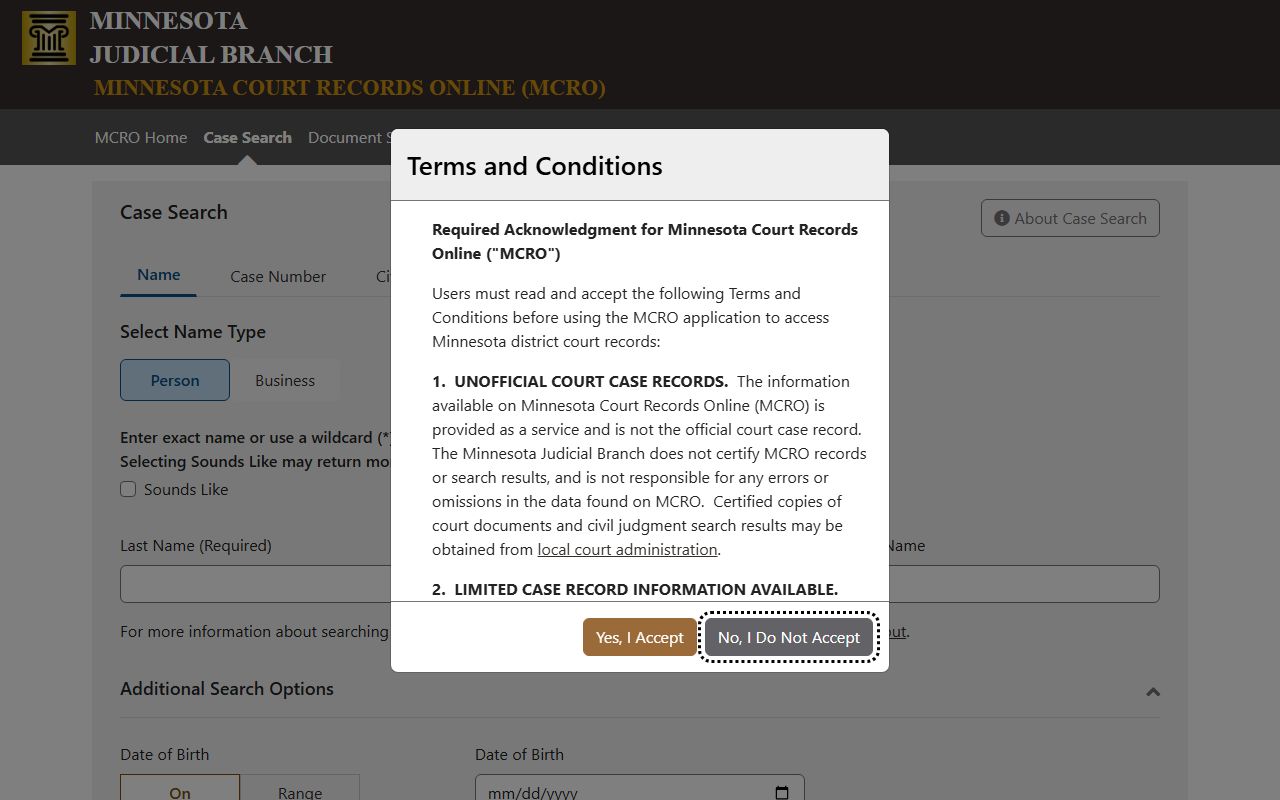
Use the case-search fields to move from a jail arrest or warrant reference to the filed court record.
Steele County Court Arrest Pathway
The local path is practical: arrest, transport, booking, identity check, search, property inventory, charge or hold coding, medical and safety screening, classification, housing, release review, first appearance, and court filing. Steele County does not publish a detailed booking manual, but its roster fields and Minnesota jail standards show how a custody record can exist before a final prosecutor filing. The roster's hold-reason field is important because it can identify a new offense, a warrant, a probation or parole violation, an under-sentence hold, work release, or a hold for another agency.
- Check the current Steele County jail roster for the booked date, arresting agency, hold reason, and charge text.
- Copy any court or warrant number shown in the roster or warrant log, especially a 74-CR criminal case number.
- Search MCRO by case number first, then by defendant name if no number is known.
- Confirm the case is in Steele County District Court before reading the charge list or hearing schedule.
- Review the Register of Actions for complaint filing, bail orders, amended charges, dispositions, and sentencing entries.
- Call Steele County District Court for official paper files or public records not available remotely.
Release timing can add confusion. Steele County states sentenced-detainee releases usually occur in the morning, while newly arraigned detainee releases usually occur in the afternoon, subject to emergencies. A person may have a court order and still remain on the jail roster until release processing is complete. The Detention Center handles custody release; the court record reflects the judge's order and case events.
Note: Jail booking text is a custody clue. MCRO is the source for public court charges filed in Steele County District Court.
Steele County Court Charging Records
Charging documents turn an arrest event into a formal court case. In Steele County, the County Attorney's Office reviews law-enforcement reports and decides whether to file charges within its authority. Court records after a jail arrest may include a complaint or other charging document if the document is public and available online. The terms sound technical, but the core point is simple: the document names the offense or offenses the state is asking the court to hear.
| Document Type | Who Uses It | Where It Fits | What To Check |
|---|---|---|---|
| Complaint | Prosecutor, often based on officer reports | Common in Minnesota criminal cases after arrest | Counts, offense dates, statute cites, charge level, and probable-cause facts |
| Information | Prosecutor | Used in some felony or post-hearing contexts | Whether it replaces or refines earlier charges |
| Indictment | Grand jury | Used for serious cases that require or involve grand-jury charging | Counts returned by the grand jury and later court orders |
Formal filings should be compared with the booking record. The jail roster may use short charge labels and hold reasons. A complaint can be more detailed and may identify counts, levels, statutes, and the factual basis for probable cause. Later court orders can change what was first filed.
Steele County Court Charge Status
Charge status shows where a count stands in court. It is not the same as custody status. A person can be released while a charge remains pending, held while a warrant is being resolved, or sentenced after conviction. Court records after a jail arrest should be checked for each count because one case can contain more than one charge and each count can move in a different way.
| Status | Meaning in the Court Record | Custody Connection |
|---|---|---|
| Pending | The charge has been filed and has not reached final disposition. | Bail, conditions, or a hold may control release. |
| Amended | The prosecutor or court changed the charge, count, or wording. | The jail roster may still show older booking text. |
| Reduced | The charge level or offense was lowered by agreement or court action. | Release terms may be reviewed after the change. |
| Dismissed | The charge was dropped by court order or prosecutor action. | Dismissal does not always mean instant release if another hold exists. |
| Convicted | The defendant was found guilty or entered a guilty plea. | Sentencing may lead to jail, probation, work release, or DOC transfer. |
| Warrant Active | A warrant exists for failure to appear, failure to comply, or another court order. | The person may be booked on the warrant and held for court. |
MCRO should be read with care when charges have been amended or partly dismissed. The charge list, Register of Actions, and disposition entries together show the current case picture. If the record is unclear, call Steele County District Court instead of relying only on a public search result.
Steele County Court Bail Records
Minnesota Rule of Criminal Procedure 6 governs release and bail decisions after arrest. A judge can release a defendant on recognizance, set conditions, set money bail, or order custody when release is not allowed under the case posture. Steele County does not publish a jail-specific online bond-posting schedule, so the controlling source is the court order, MCRO case record, warrant log, or a direct confirmation call to the Detention Center or District Court.
| Release or Bail Term | Plain Meaning | What To Confirm |
|---|---|---|
| Recognizance or PR | Release based on a promise to appear and obey court orders. | Check for written conditions and next hearing dates. |
| Money Bail | A cash or surety amount set under the court's release order. | Confirm the amount with court or jail before payment. |
| Conditional Release | Release with rules such as no contact, testing, or location limits. | Read all conditions because violation can lead to a warrant. |
| Sign and Release | A warrant-log note that may allow release after signing court paperwork. | Do not act until the issuing agency confirms it. |
| Hold Without Bond | A hold that does not list a bond amount for release. | Ask whether a court appearance or other agency controls custody. |
| Hold for Court | The person must be brought before court before release can be decided. | Check MCRO and call court or jail for the next appearance. |
Minnesota Rule of Criminal Procedure 6 also requires written release orders, and Minn. Stat. 629.74 requires pretrial bail evaluations for specified detained defendants. That can matter in Steele County cases involving violence, domestic issues, harassment, or other qualifying offenses. Public roster and warrant text is a starting point, not the final word.
Steele County Warrant Court Records
Steele County publishes an official warrant overview page and a warrant-list PDF. The county explains that District Court issues arrest warrants, then forwards them to the Sheriff for enforcement. Most warrants are for failure to respond to court or failure to carry out a court order. Probation arrest and detention orders can also be entered into the Sheriff's warrant system.
The county gives a clear warning: do not take action on a warrant based only on website information. Warrants must be confirmed by the issuing agency before enforcement. Updates can lag after court action, and the public warrant database may differ from court records or the Sheriff's Office warrant system. The posted update schedule is weekdays at 9 a.m., but the case record and direct confirmation are still the better sources before a person acts on a warrant or bail note.
| Warrant Field | What It Shows | How It Connects To Court Records |
|---|---|---|
| Name | The person named in the warrant. | Use it to compare roster, warrant, and MCRO results. |
| Warrant Number | The warrant identifier, often with a court case number. | Search MCRO by case number when a 74-CR number appears. |
| Offense | The alleged offense or court-failure reason. | Compare it with filed charges and docket entries. |
| Charge Level | Examples include misdemeanor, gross misdemeanor, or felony labels. | Check whether the court case later changed the level. |
| Bail Amount | A dollar amount or text such as hold without bond. | Confirm with jail or District Court before relying on it. |
The access chain for warrants is the public warrant list, Detention Center phone, District Court phone, MCRO case-number search, sheriff records request, and in-person confirmation at the appropriate counter. No app-only Steele County warrant lookup was identified in the research.
Steele County Charge Records Compared
A charge is an accusation filed in court. A conviction is the result of a guilty plea, guilty verdict, or other final finding of guilt. Steele County court records after an arrest can show charges that never become convictions. That is why employers, landlords, licensing boards, and the public should not treat a booking or pending charge as proof that the person committed the offense.
| Point | Charge | Conviction |
|---|---|---|
| Stage | Filed after prosecutor review or warrant activity. | Entered after plea, verdict, or other final disposition. |
| Proof Level | Based on legal grounds to accuse and proceed. | Requires a guilty plea or proof beyond a reasonable doubt. |
| Where To See It | MCRO charge list, complaint, Register of Actions. | MCRO disposition entries and BCA public conviction history when eligible. |
| Can Change | May be amended, added, reduced, or dismissed. | May still be affected by appeal, correction, or expungement. |
The official Minnesota Public Criminal History search from DPS/BCA is narrower than MCRO. It lists public conviction data, not raw arrest data. It excludes juvenile data, federal data, out-of-state records, arrest-only records, and older post-sentence convictions that are no longer public through that system. Use it for statewide public conviction history, not for every Steele County court event after a jail arrest.
Steele County Sealed Court Records
Minnesota public access rules allow many jail, law-enforcement, and court records to be viewed, but not all records stay public in the same way. Juvenile matters, sealed files, active investigations, and nonpublic data may be withheld. Minnesota's Government Data Practices Act controls public government data, while court access rules and case-specific orders control many court documents.
| Point | Sealed | Expunged |
|---|---|---|
| Public View | Hidden from ordinary public access by law or court order. | Sealed through the expungement process when granted. |
| Record Exists | The record can still exist in government systems. | The record is not erased in every system unless the order says so. |
| Access By Agencies | Some agencies may retain limited access. | Access depends on Minnesota law and the specific expungement order. |
| How It Happens | May occur by rule, case type, or court order. | Petition process under Minnesota law when automatic relief does not apply. |
Minn. Stat. 609A.03 describes the petition process for criminal expungement when automatic expungement does not apply. Expungement is not the same as proving that no arrest occurred. It is a court process that can limit public access to eligible records after dismissal, acquittal, diversion, stay, conviction, or other qualifying outcomes. Anyone relying on an old Steele County arrest should check the current court record before drawing conclusions.
Important: Public-record lookup material is not a consumer report and must not be used for FCRA-covered screening.
Steele County Court Access Limits
Several Minnesota laws shape what can be found after a Steele County jail arrest. Minn. Stat. 13.03 gives public access to public government data and sets request and copy rules. Minn. Stat. 13.82 governs law-enforcement data, including arrest and booking information. Minn. Stat. 13.87 governs criminal-history data and helps explain why BCA public criminal history is conviction-focused rather than a full arrest database.
For jail records that are not clear from the roster, Steele County provides sheriff and county data request routes. Public data inspection is generally free, while copies may have costs and may require prepayment when the county form says so. For court records that do not appear in MCRO, the next step is Steele County District Court. For custody notification, Steele County points victims and interested parties toward VINE/VINELink rather than MCRO.
- Detainer
- A request or hold from another agency that can keep a person in custody after a local issue changes.
- Register of Actions
- The court docket list showing public case events, filings, hearings, orders, and dispositions.
- PR Release
- Release on personal recognizance, based on a promise to appear and follow court orders.
- Disposition
- The court result for a charge, such as dismissed, convicted, or another final outcome.
Restricted Steele County Court Records
Not every record tied to an arrest is available to the public online. MCRO remote access is limited to public district court case records that may be shown online under court rules. Juvenile cases, sealed matters, confidential filings, certain victim information, and documents withheld by rule or order may not appear. Law-enforcement data can also be withheld if release would affect an active investigation.
The best practice is to use the right system for the right question. Use the jail roster and Detention Center for present custody. Use MCRO and Steele County District Court for filed criminal cases. Use the County Attorney's Office role information to understand who files charges. Use BCA public criminal history for eligible Minnesota conviction data only. Use Minnesota expungement law and court orders when a record may no longer be public.